
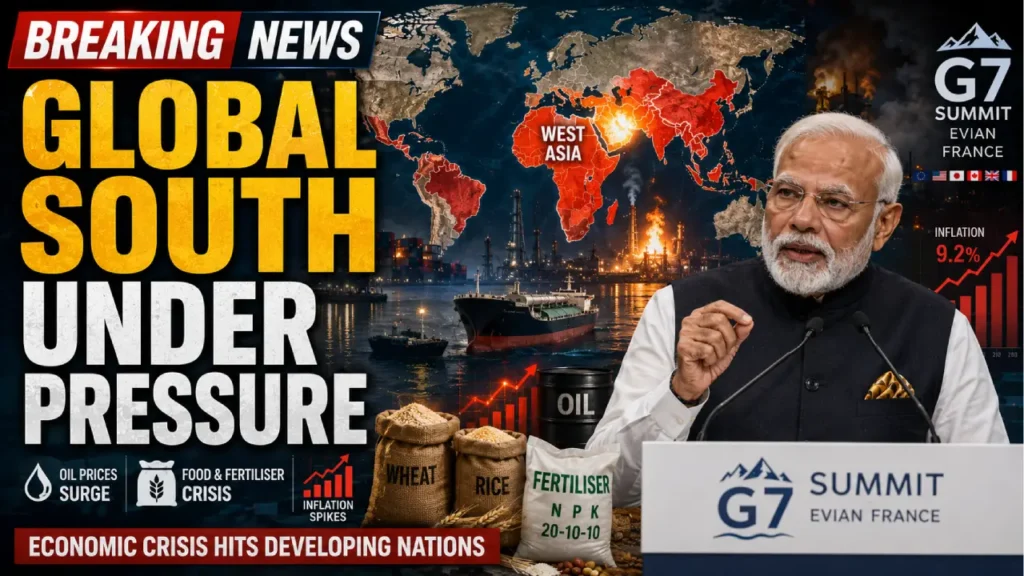
PM Modi Raises a Serious Warning at G7 Summit
The Global South Impact from West Asia Conflict emerged as one of the most important issues discussed during the G7 Summit, as Prime Minister Narendra Modi warned world leaders that the ongoing crisis in West Asia could continue affecting developing nations for a considerable period.
Speaking during discussions with global leaders, PM Modi highlighted how disruptions in fuel, fertiliser and food supply chains are creating economic pressure on countries across Asia, Africa and Latin America.
The warning comes at a time when many developing nations are still recovering from the effects of previous global economic shocks, inflation, supply chain disruptions and rising debt burdens.
According to PM Modi, the consequences of the West Asia crisis are not limited to the region itself. Instead, they are being felt across the developing world, where millions of people depend on stable food supplies, affordable energy and accessible fertilisers for agriculture.
The Global South Impact from West Asia Conflict is therefore becoming a major concern for governments, businesses and international organizations alike.
Key Highlights
- PM Modi raised concerns about the Global South Impact from West Asia Conflict
- Warning delivered during discussions at the G7 Summit
- Fuel supply disruptions remain a major concern
- Fertiliser availability could be affected for months
- Food supply chains face increasing pressure
- Developing countries are particularly vulnerable
- Rising costs could worsen inflation in many nations
- India called for dialogue, stability and cooperation
What Did PM Modi Say?
During the G7 Summit, PM Modi stressed that the ongoing conflict in West Asia is having consequences far beyond the region.
He warned that disruptions in:
- Fuel supply chains
- Fertiliser supply chains
- Food supply chains
could continue affecting developing countries for a long time.
According to PM Modi, the Global South Impact from West Asia Conflict is particularly serious because many developing nations already face economic challenges and have limited resources to absorb additional shocks.
His remarks reflected growing concern among emerging economies about the long-term effects of geopolitical instability on everyday life.
Why the Global South Is More Vulnerable
The term “Global South” generally refers to developing and emerging economies across Asia, Africa, Latin America and parts of Oceania.
Many of these countries depend heavily on imported:
- Energy
- Fertilisers
- Food commodities
- Industrial raw materials
When supply chains are disrupted, these nations often experience stronger economic impacts than wealthier countries.
The Global South Impact from West Asia Conflict is therefore expected to be more severe because developing economies have fewer financial resources to manage rising costs.
How the West Asia Conflict Is Affecting Fuel Supplies
One of the biggest concerns is energy security.
West Asia remains one of the world’s most important energy-producing regions.
A large share of global:
- Crude Oil
- Natural Gas
- Petroleum Products
passes through strategic maritime routes connected to the region.
Any disruption can create uncertainty in international energy markets.
The Global South Impact from West Asia Conflict becomes visible when fuel prices increase, transportation costs rise and inflation spreads throughout economies.
Countries that import large quantities of oil may face growing financial pressure if prices remain elevated.
Rising Energy Costs and Their Impact
Higher energy prices affect almost every sector.
Transportation
Fuel costs increase for airlines, shipping companies and road transport operators.
Manufacturing
Factories face higher production expenses.
Agriculture
Farmers spend more on machinery, irrigation and transportation.
Consumers
Households ultimately pay more for goods and services.
As a result, the Global South Impact from West Asia Conflict can directly affect living standards for millions of people.
Fertiliser Supply Chains Under Pressure
Another major concern highlighted by PM Modi is fertiliser availability.
Many developing countries rely on imported fertilisers to support agricultural production.
Supply disruptions can create:
- Higher fertiliser prices
- Lower agricultural productivity
- Reduced crop yields
- Increased food insecurity
For nations where agriculture remains a key economic sector, fertiliser shortages can have serious consequences.
The Global South Impact from West Asia Conflict is therefore closely linked to agricultural stability and food production.
Why Fertilisers Matter So Much
Modern agriculture depends heavily on fertilisers.
Without adequate supplies, farmers may struggle to maintain production levels.
This can lead to:
- Lower harvests
- Reduced food availability
- Higher food prices
- Increased pressure on governments
Experts warn that prolonged supply chain disruptions could affect agricultural planning across multiple regions.
Food Supply Chains Face New Risks
Food security remains one of the biggest concerns for developing nations.
The Global South Impact from West Asia Conflict extends beyond fuel and fertilisers because food supply chains are interconnected with both sectors.
Higher transportation costs increase food prices.
Fertiliser shortages reduce crop production.
Supply chain delays create additional market uncertainty.
Together, these factors can place pressure on consumers and governments alike.
Why Food Inflation Matters
Food inflation has a direct impact on families.
When food prices rise:
- Household budgets come under pressure
- Poverty risks increase
- Nutrition challenges become more severe
- Governments face growing social and economic demands
Many developing nations are already dealing with inflation concerns, making the Global South Impact from West Asia Conflict particularly important.
India’s Position on the West Asia Crisis
India has consistently emphasized the importance of dialogue, diplomacy and peaceful resolution of conflicts.
At the G7 Summit, PM Modi stressed that stability in West Asia is not only important for the region but also for the wider world.
India believes that continued instability could:
- Affect global trade
- Increase energy costs
- Disrupt food security
- Slow economic growth
By highlighting the Global South Impact from West Asia Conflict, PM Modi sought to draw international attention to the concerns of developing nations.
What Economic Experts Are Saying
Economists and policy analysts believe that the risks identified by PM Modi are real and significant.
Experts point to several key concerns:
Persistent Inflation
Higher energy and food costs can sustain inflationary pressure.
Slower Growth
Developing economies may experience weaker growth if costs continue rising.
Fiscal Challenges
Governments may need to increase subsidies and social support programs.
Food Security Risks
Agricultural sectors could face difficulties if fertiliser supplies remain unstable.
The Global South Impact from West Asia Conflict is therefore being closely monitored by international financial institutions and policymakers.
How Global Trade Could Be Affected
Global trade relies heavily on stable shipping routes and predictable supply chains.
The West Asia region plays a crucial role in:
- Energy exports
- Maritime transport
- International commerce
Any prolonged disruption could affect:
- Shipping costs
- Insurance premiums
- Trade volumes
- Supply chain efficiency
This is another reason why the Global South Impact from West Asia Conflict has become a major issue on the international agenda.
What Happens Next?
Several developments will be closely watched in the coming months.
These include:
Diplomatic Efforts
International leaders are expected to continue seeking peaceful solutions.
Energy Market Stability
Governments and businesses will monitor oil and gas prices.
Food Supply Conditions
Agricultural markets will remain under close observation.
Global Economic Outlook
International institutions may revise forecasts depending on how the situation evolves.
The Global South Impact from West Asia Conflict will likely remain a major focus for policymakers and economic experts throughout the year.
The Global South Impact from West Asia Conflict has become one of the most significant economic concerns facing developing nations today.
At the G7 Summit, PM Modi delivered a strong warning that disruptions in fuel, fertiliser and food supply chains could continue affecting millions of people across the developing world for a considerable period.
His remarks highlighted the interconnected nature of today’s global economy, where conflicts in one region can quickly influence energy prices, food security and economic stability in countries thousands of kilometers away.
As governments work to address these challenges, the message from PM Modi was clear: protecting the interests of the Global South must remain a priority in global decision-making.
The coming months will be crucial in determining whether international cooperation can help reduce the risks and ensure greater stability for developing nations.
click on ‘Read more‘ for the latest news