
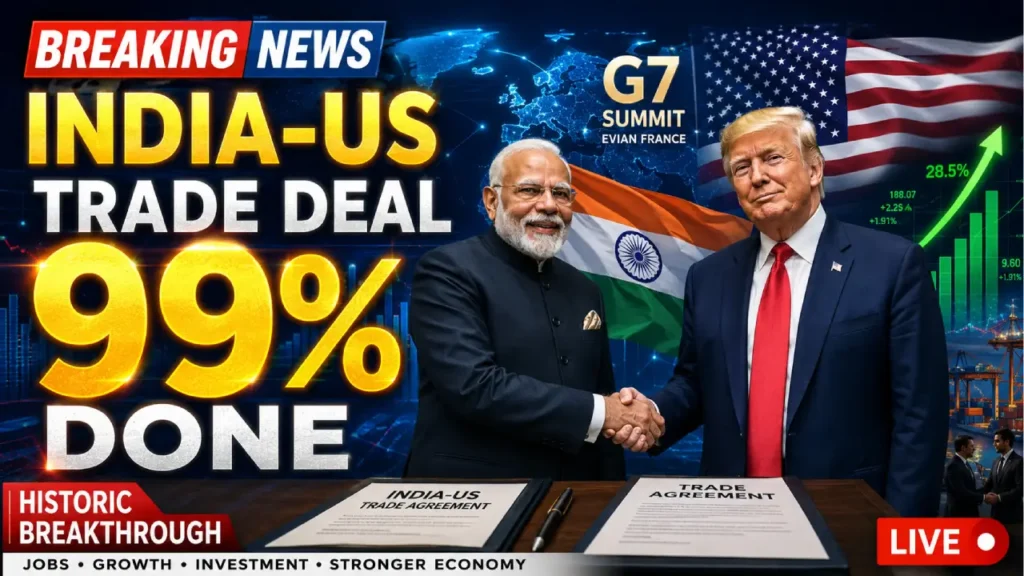
A Major Economic Moment Could Be Just Around the Corner
A significant development in global trade emerged from the G7 Summit in Evian, France, where Prime Minister Narendra Modi and President Donald Trump held high-level talks that may reshape economic relations between India and the United States.
The biggest takeaway from the meeting was the strong signal that the India-US Trade Deal is now approaching the finish line. Both leaders expressed confidence that negotiations for an interim Bilateral Trade Agreement have made substantial progress.
President Trump told reporters that the two countries are “very close” to reaching a deal, while Indian officials indicated that discussions are nearly 99 percent complete. The upcoming visit of U.S. Trade Representative Jamieson Greer to India is expected to play a crucial role in finalizing the remaining details.
If successful, the agreement could become one of the most important economic developments of 2026 and pave the way for deeper cooperation between two of the world’s largest economies.
Key Highlights
- PM Modi and President Trump met during the G7 Summit in Evian.
- Both leaders reported significant progress on the India-US Trade Deal.
- Trump said the agreement is “very close” to completion.
- Indian officials indicated negotiations are nearly 99% complete.
- U.S. Trade Representative Jamieson Greer is expected to visit India next week.
- Both nations aim to increase bilateral trade to $500 billion by 2030.
- Discussions include tariffs, market access, technology, manufacturing, and investment.
- Officials have been directed to conclude the agreement as soon as possible.
What is the India-US Trade Deal?
The India-US Trade Deal refers to an interim Bilateral Trade Agreement currently being negotiated between India and the United States.
The agreement aims to reduce trade barriers, improve market access, strengthen investment opportunities, and boost economic cooperation across multiple sectors.
Trade discussions have been ongoing for several months, involving officials from both governments. Areas under negotiation include:
- Tariffs and customs duties
- Agriculture and food products
- Digital trade
- Technology cooperation
- Manufacturing partnerships
- Supply chain resilience
- Investment facilitation
The proposed agreement is viewed as an important step toward a broader economic partnership between the two countries.
PM Modi and Trump Hold High-Level Talks at G7 Summit
The meeting between PM Modi and President Trump took place on the sidelines of the G7 Summit in Evian, France.
According to official statements, both leaders reviewed the progress made in trade negotiations and expressed satisfaction with the advancements achieved so far.
The leaders emphasized the importance of strengthening economic cooperation and instructed their respective teams to accelerate discussions and complete the agreement at the earliest opportunity.
The meeting also covered strategic issues, technology partnerships, energy cooperation, defense collaboration, and global economic developments.
The positive tone of the discussions has been interpreted as a strong indication that both governments are committed to concluding the trade agreement soon.
Trump Says the Deal is “Very Close”
One of the most discussed moments after the meeting came when President Trump described the trade negotiations as being “very close” to a successful conclusion.
His statement suggests that most major issues have already been resolved and only a few technical details remain under discussion.
Trade experts believe such public confidence from the U.S. President is a strong signal that both sides are working toward an early announcement.
Trump also acknowledged India’s growing importance in global trade and highlighted the economic potential of stronger cooperation between the two countries.
India Indicates Negotiations Are Nearly 99% Complete
Indian officials have also expressed optimism about the progress made.
Recent comments from Indian trade negotiators suggest that the first phase of the agreement is almost finalized, with negotiations reportedly reaching around 99 percent completion.
While some technical and sector-specific issues remain unresolved, both governments appear confident that these differences can be addressed through continued dialogue.
This level of progress is significant considering the complexity of trade negotiations involving two major economies.
Why the India-US Trade Deal 2026 Matters
The importance of the India-US Trade Deal extends beyond trade numbers.
India and the United States are among the world’s largest economies and increasingly important strategic partners.
A successful agreement could:
- Increase bilateral trade
- Encourage foreign investment
- Create jobs
- Strengthen supply chains
- Promote manufacturing growth
- Enhance technology cooperation
- Improve market access for businesses
For companies in both countries, the agreement could reduce uncertainty and open new commercial opportunities.
The Goal: $500 Billion in Bilateral Trade
India and the United States have set an ambitious target of reaching $500 billion in bilateral trade by 2030.
Achieving this goal will require:
Expanding Market Access
Businesses from both countries want easier access to each other’s markets.
Reducing Trade Barriers
Lower tariffs and simplified regulations could encourage higher trade volumes.
Encouraging Investment
The agreement is expected to support new investments in manufacturing, technology, and infrastructure.
Strengthening Supply Chains
Global supply chains have faced disruptions in recent years. Both nations want more resilient and diversified trade networks.
The India-US Trade Deal is widely seen as a critical step toward achieving these objectives.
Major Issues Discussed During Negotiations
Tariffs
Tariffs have been one of the most sensitive areas of discussion.
Both countries have sought improved access for their products while protecting key domestic industries.
Agriculture
Agricultural products remain an important topic in the negotiations.
Market access, quality standards, and import regulations have all been discussed extensively.
Digital Trade
Digital services and technology cooperation are becoming increasingly important.
Negotiators are working to establish frameworks that support innovation while protecting national interests.
Manufacturing
Manufacturing cooperation is expected to be a major beneficiary of the agreement.
India’s growing industrial sector and America’s advanced manufacturing capabilities could complement each other.
Investment and Business Cooperation
Both governments are seeking ways to make cross-border investments easier and more attractive.
U.S. Trade Representative’s Visit Could Be Decisive
The upcoming visit of U.S. Trade Representative Jamieson Greer to India is expected to be one of the most important events in the negotiation process.
Trade officials from both countries will likely review the remaining unresolved issues and attempt to finalize the text of the agreement.
Experts believe that if the visit produces positive outcomes, an official announcement could follow shortly afterward.
Many business groups are closely watching the discussions because the agreement could influence investment decisions and future trade strategies.
Benefits for India
If implemented successfully, the India-US Trade Deal could provide several advantages for India.
Higher Exports
Indian exporters could gain improved access to the American market.
Manufacturing Growth
The agreement could support initiatives aimed at expanding domestic manufacturing.
Increased Foreign Investment
American companies may invest more heavily in Indian industries.
Job Creation
New investments and business opportunities could generate employment across multiple sectors.
Technology Partnerships
India could benefit from deeper collaboration in advanced technologies and innovation.
Benefits for the United States
The agreement also offers significant opportunities for the United States.
Access to a Large Market
India remains one of the world’s fastest-growing major economies.
Business Expansion
American companies could gain new opportunities in sectors ranging from technology to healthcare.
Supply Chain Diversification
Stronger trade ties with India could help reduce dependence on concentrated supply chains.
Strategic Economic Cooperation
Closer economic ties support broader strategic relations between the two democracies.
Global Economic Impact
The world economy continues to face uncertainty due to geopolitical tensions, supply chain challenges, and fluctuating energy markets.
In such an environment, a successful India-US Trade Deal could send a positive signal to global markets.
The agreement would demonstrate that major economies can continue pursuing economic cooperation despite broader global challenges.
Investors and international businesses are therefore paying close attention to developments surrounding the negotiations.
Expert Views
Economic analysts believe the proposed agreement could have long-term benefits.
According to trade experts, stronger economic integration between India and the United States may:
- Boost economic growth
- Increase business confidence
- Attract investment
- Enhance innovation
- Support employment generation
- Strengthen global supply chains
Many experts view the agreement as more than a trade deal. They see it as part of a broader economic and strategic partnership that could shape future global trade patterns.
What Happens Next
The next few weeks are expected to be critical.
Key developments to watch include:
- Visit of U.S. Trade Representative Jamieson Greer to India
- Final technical discussions
- Resolution of remaining trade issues
- Possible announcement of the first phase of the agreement
- New roadmap for broader economic cooperation
If negotiations continue at the current pace, the India-US Trade Deal could soon move from discussion to implementation.
The meeting between PM Modi and President Trump at the G7 Summit has provided fresh momentum to the India-US Trade Deal.
With both leaders expressing confidence and negotiators reporting near-complete progress, the agreement appears closer than ever before.
While some final details remain under discussion, the overall direction is clear: India and the United States are working toward a major trade partnership that could significantly strengthen economic ties, increase investment, create jobs, and support long-term growth.
If finalized in the coming weeks, the agreement could become one of the defining economic developments of 2026 and a major milestone in India-US relations.
click on ‘Read more‘ for the latest news