
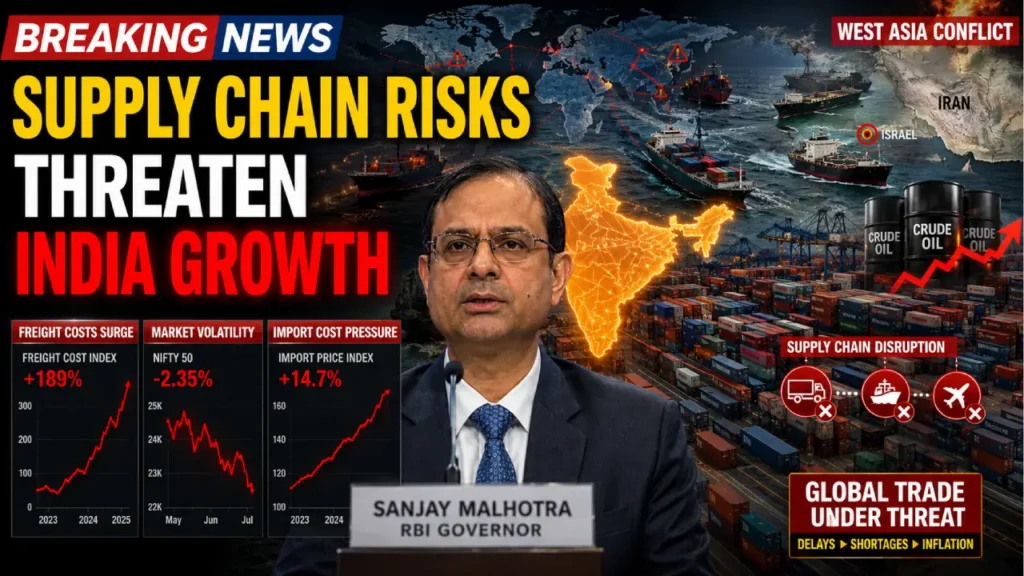
India’s economy has remained resilient despite multiple global challenges over the past few years. Strong domestic demand, government infrastructure spending, a growing services sector, and healthy investment activity have helped the country maintain its position as one of the world’s fastest-growing major economies.
However, fresh concerns are emerging from global markets.
In its latest assessment, the Reserve Bank of India (RBI) stated that Global Supply Chain Disruptions Pose Downside Risks to India’s domestic growth outlook. The central bank highlighted that prolonged disruptions in international supply chains, rising geopolitical tensions in West Asia, increasing energy costs, and weather-related shocks could create significant challenges for economic growth in FY2026-27.
The RBI also emphasized that the overall economic impact will largely depend on how long the West Asia conflict continues and whether global trade routes remain affected.
For businesses, investors, exporters, manufacturers, and consumers, this warning carries important implications.
What Did RBI Say?
The RBI has acknowledged that India’s economic fundamentals remain relatively strong. However, policymakers are becoming increasingly cautious about external risks.
According to the central bank, global trade and logistics networks continue to face uncertainty due to ongoing geopolitical tensions.
The RBI noted that Global Supply Chain Disruptions Pose Downside Risks because disruptions can increase transportation costs, delay shipments, raise input prices, and affect production across multiple industries.
At the same time, extreme weather events and climate-related disruptions are adding another layer of uncertainty to economic activity.
The central bank believes these risks could influence growth, inflation, investment, and overall business confidence during FY27.
Key Highlights
- RBI warns that Global Supply Chain Disruptions Pose Downside Risks
- West Asia conflict remains a major concern
- Energy prices could stay elevated
- Shipping routes face potential disruptions
- Weather-related shocks remain a growing risk
- Manufacturing costs may rise
- Inflation pressures could increase
- Export and import activities may face challenges
- Domestic demand remains supportive
- India continues to show economic resilience
Why Global Supply Chain Disruptions Pose Downside Risks for India
Global supply chains connect manufacturers, exporters, importers, transport operators, and consumers across countries.
When disruptions occur, the impact can spread quickly throughout the economy.
Impact of West Asia Conflict
The ongoing conflict in West Asia has become one of the biggest concerns for global trade.
The region plays a crucial role in global energy production and transportation.
Several important shipping routes pass through or near the region. Any escalation can increase risks for commercial shipping operations.
Higher insurance costs, longer transportation routes, and security concerns can increase logistics expenses.
For India, which imports large quantities of crude oil and industrial inputs, these developments can create economic challenges.
Rising Energy Prices Add Pressure
Energy remains a critical component of economic activity.
The conflict in West Asia has increased uncertainty in global oil markets.
When crude oil prices rise:
- Transportation costs increase
- Manufacturing becomes more expensive
- Logistics expenses rise
- Consumer prices face upward pressure
India imports a significant share of its energy requirements. As a result, prolonged increases in oil prices can directly affect economic growth.
This is one of the main reasons why Global Supply Chain Disruptions Pose Downside Risks according to RBI.
Shipping Delays and Logistics Challenges
Global trade depends heavily on efficient transportation networks.
Disruptions in shipping routes can create several problems:
Delayed Deliveries
Companies may face delays in receiving raw materials and components.
Higher Freight Costs
Shipping companies may charge higher rates due to increased risks and longer routes.
Reduced Inventory Efficiency
Businesses may need to hold larger inventories to protect against disruptions.
Increased Business Costs
All these factors contribute to higher operational expenses.
For industries operating on thin margins, these additional costs can become significant.
Global Supply Chain Disruptions Pose Downside Risks to Manufacturing Sector
Manufacturing is one of the sectors most vulnerable to supply-chain disruptions.
Modern manufacturing relies on global sourcing networks.
Many industries import:
- Electronic components
- Machinery parts
- Industrial chemicals
- Metals
- Energy products
When supply chains are disrupted, manufacturers often face:
- Production delays
- Cost increases
- Reduced profitability
- Delivery challenges
These issues can slow industrial growth and impact employment generation.
Automobile Industry Could Face Challenges
India’s automobile industry depends on a complex network of suppliers.
Even small disruptions in component supplies can affect production schedules.
If transportation costs continue to rise, automobile manufacturers may face higher costs for:
- Raw materials
- Imported components
- Distribution networks
Consumers may ultimately see higher vehicle prices.
Electronics Sector Remains Sensitive
The electronics industry relies heavily on international supply chains.
Many essential components are sourced globally.
Supply disruptions can:
- Delay product launches
- Increase manufacturing costs
- Affect export competitiveness
As India seeks to expand electronics manufacturing, stable supply chains remain crucial.
Weather-Related Shocks Add Another Risk
The RBI also highlighted weather-related shocks as a growing concern.
Climate events can affect:
- Agriculture
- Food production
- Transportation
- Infrastructure
India remains highly dependent on monsoon performance.
Poor rainfall patterns, floods, heatwaves, or cyclones can influence agricultural output and rural demand.
This is why weather uncertainty has become an increasingly important economic risk.
Impact on Agriculture
Agriculture remains an important contributor to India’s economy.
Extreme weather conditions can lead to:
- Lower crop yields
- Supply shortages
- Food inflation
- Reduced rural income
These developments can affect overall economic growth.
Impact on Food Inflation
Weather disruptions often lead to volatility in food prices.
If agricultural production declines, food inflation may increase.
Higher food prices can reduce household purchasing power and affect consumer spending.
This can create additional pressure on economic growth.
Global Supply Chain Disruptions Pose Downside Risks for Inflation Outlook
Inflation remains one of the biggest concerns for policymakers.
Supply chain disruptions can increase prices across multiple sectors.
Fuel Inflation
Higher energy costs directly affect transportation and production.
This often leads to rising prices across the economy.
Industrial Inflation
Manufacturers facing higher input costs may pass some expenses on to consumers.
This can contribute to broader inflationary pressures.
Food Inflation
Weather-related disruptions can affect agricultural supply and increase food prices.
Combined with higher transportation costs, this can further raise inflation.
The RBI continues to monitor these risks carefully.
India’s Strengths Amid Global Challenges
Despite these concerns, India has several factors working in its favor.
Strong Domestic Demand
Consumer spending continues to support economic activity.
A large domestic market provides resilience against external shocks.
Government Infrastructure Investment
Major investments in:
- Highways
- Railways
- Airports
- Ports
- Digital Infrastructure
continue to support growth and employment.
Services Sector Growth
India’s services sector remains a key economic driver.
Industries such as:
- Information Technology
- Financial Services
- Healthcare
- Telecommunications
continue to contribute significantly to GDP growth.
Growing Manufacturing Base
Government initiatives aimed at boosting domestic manufacturing may help reduce dependence on imported products over time.
This could improve resilience against future supply-chain disruptions.
What Businesses Should Watch
Companies should closely monitor developments related to:
West Asia Conflict
The duration and intensity of the conflict will significantly influence global markets.
Crude Oil Prices
Energy costs remain one of the biggest risks.
Shipping Costs
Freight rates can directly affect profitability.
Weather Conditions
Agricultural output and food prices depend heavily on weather patterns.
Global Trade Activity
Any slowdown in global demand could affect exports.
Expert Analysis
Economic experts generally agree that the RBI’s warning is justified.
Many analysts believe that Global Supply Chain Disruptions Pose Downside Risks because global trade remains vulnerable to geopolitical events.
However, experts also point out that India is relatively better positioned than many economies due to:
- Strong domestic consumption
- Infrastructure spending
- A diversified economy
- A growing services sector
- Improved financial stability
These strengths can help absorb some external shocks.
What Happens Next?
Several factors will determine how serious the risks become in FY27.
Key Developments to Watch
- Duration of the West Asia conflict
- Global crude oil price movements
- Shipping route stability
- Global trade performance
- Inflation trends
- Monsoon performance
- Foreign investment flows
If geopolitical tensions ease and supply chains stabilize, growth prospects could improve significantly.
However, prolonged disruptions may continue to create challenges for businesses and consumers.
The RBI’s warning that Global Supply Chain Disruptions Pose Downside Risks reflects growing uncertainty in the global economic environment.
The ongoing West Asia conflict, rising energy prices, logistics bottlenecks, and weather-related shocks have increased risks to growth and inflation. While India’s economy remains fundamentally strong, these external challenges require careful monitoring.
Strong domestic demand, infrastructure development, services sector expansion, and ongoing economic reforms continue to support growth. However, the duration of geopolitical tensions and the stability of global supply chains will play a critical role in determining India’s economic performance during FY27.
For businesses, investors, and policymakers, the coming months will be crucial in assessing how these risks evolve and how effectively the economy adapts to changing global conditions.
click on ‘Read more‘ for the latest news