
India remains one of the fastest-growing major economies in the world. However, fresh concerns over geopolitical tensions, rising crude oil prices and disruptions in global supply chains have forced the Reserve Bank of India (RBI) to revise its growth outlook.
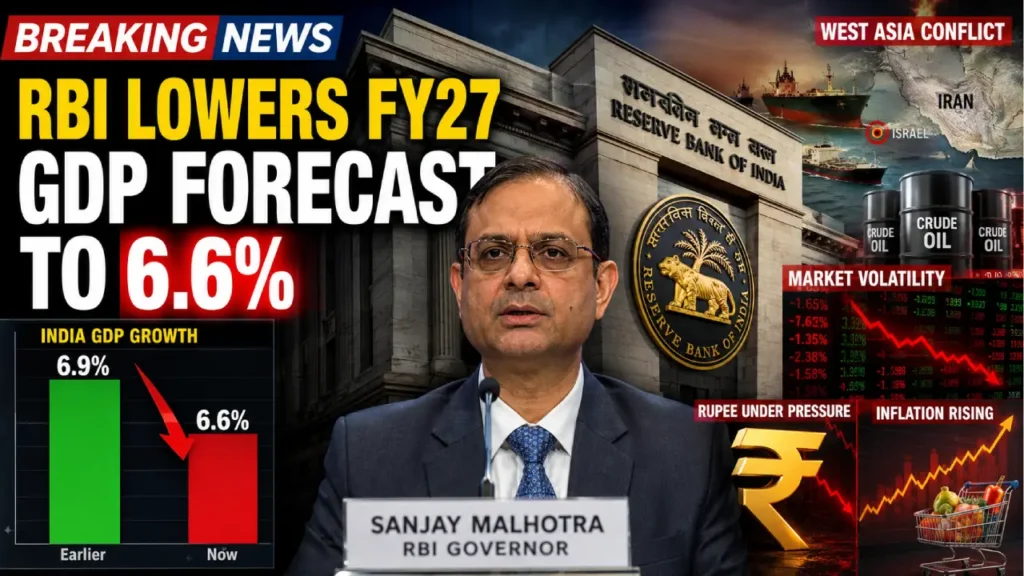
The big headline is that RBI Lowers FY27 GDP Forecast to 6.6%, reducing its earlier projection of 6.9% for the financial year 2026-27. The central bank has pointed to the ongoing West Asia conflict, elevated energy costs, global financial market volatility and uncertainty in international trade as key risks to economic growth.
Despite the downgrade, RBI believes that India’s economic fundamentals remain strong. Domestic demand continues to support growth, investment activity remains healthy and the services sector is showing resilience.
The decision has sparked discussions among economists, businesses, investors and policymakers about the future direction of the Indian economy.
What Happened?
During its latest monetary policy review, the Reserve Bank of India revised its FY27 GDP growth estimate from 6.9% to 6.6%.
The central bank stated that the global environment has become more uncertain due to escalating tensions in West Asia. Higher crude oil prices, disruptions in energy supply routes and increased volatility in international financial markets are creating downside risks for growth.
At the same time, RBI maintained that India is better positioned than many other economies because of strong domestic consumption, government infrastructure spending and a growing services sector.
Key Highlights
- RBI lowers FY27 GDP forecast from 6.9% to 6.6%
- West Asia conflict identified as a major risk
- Rising crude oil and energy prices impacting outlook
- Supply chain disruptions remain a concern
- Global financial market volatility increasing uncertainty
- Domestic demand continues to support growth
- Infrastructure investment remains strong
- Services sector showing resilience
- Inflation risks remain elevated
- India still among the fastest-growing major economies
Why RBI Lowers FY27 GDP Forecast to 6.6%
Several global and domestic factors influenced RBI’s decision to revise its growth estimate.
West Asia Conflict Creates Economic Uncertainty
One of the biggest concerns highlighted by RBI is the ongoing conflict in West Asia.
The region is strategically important for global energy supplies. Any disruption in oil production or transportation can have a significant impact on energy-importing countries such as India.
As tensions rise, concerns about supply shortages and higher transportation costs also increase.
This uncertainty has forced policymakers to adopt a more cautious approach toward economic growth projections.
Rising Crude Oil Prices
India imports a large portion of its crude oil requirements.
When global crude oil prices increase, the country’s import bill rises significantly. Higher fuel costs affect almost every sector of the economy.
Transportation becomes more expensive. Manufacturing costs increase. Logistics operations face higher expenses. Consumers ultimately feel the impact through rising prices.
Because of these factors, sustained increases in crude oil prices can slow economic growth.
Supply Chain Disruptions Continue
Global supply chains have improved compared to previous years, but they remain vulnerable to geopolitical conflicts.
Shipping routes passing through critical regions can face delays, increased insurance costs and logistical challenges.
For businesses, this means:
- Higher transportation costs
- Delayed delivery schedules
- Increased raw material expenses
- Reduced operational efficiency
Such disruptions can directly impact industrial production and economic growth.
Global Financial Market Volatility
Another major factor behind the revised forecast is increased volatility in international financial markets.
Investors tend to become cautious during periods of geopolitical uncertainty.
This can result in:
- Capital outflows from emerging markets
- Currency fluctuations
- Reduced foreign investment
- Higher borrowing costs
India has relatively strong financial fundamentals, but global market uncertainty can still affect investor sentiment.
RBI Lowers FY27 GDP Forecast to 6.6%: Impact on India Economy
The downgrade does not indicate an economic crisis. Instead, it reflects a more realistic assessment of global risks.
India’s economy continues to benefit from several structural strengths.
Strong Domestic Consumption
Household spending remains one of the strongest pillars of economic growth.
Urban consumption is showing healthy momentum, while rural demand is gradually improving.
Strong consumer demand helps support businesses across sectors including retail, automobiles, housing and services.
Government Infrastructure Push
Large investments in infrastructure continue to play a critical role in supporting economic activity.
Projects involving:
- Highways
- Railways
- Airports
- Ports
- Digital infrastructure
are generating employment and stimulating demand across multiple industries.
This spending helps offset some of the challenges arising from global uncertainty.
Services Sector Remains Resilient
India’s services sector continues to perform strongly.
Industries such as:
- Information Technology
- Financial Services
- Telecommunications
- Healthcare
- Professional Services
remain major contributors to economic growth.
The sector continues to attract investments and create employment opportunities.
Manufacturing Sector Faces Mixed Outlook
Manufacturing activity remains positive, but higher energy costs could create challenges.
Industries dependent on imported fuel and raw materials may face margin pressures if global commodity prices remain elevated.
However, government initiatives supporting domestic manufacturing could help reduce some of these risks.
Impact on Inflation
One of the biggest concerns associated with the revised growth forecast is inflation.
Higher energy prices can affect the entire economy.
Fuel Costs
Rising crude oil prices increase the cost of petrol, diesel and other fuels.
This affects transportation costs and logistics operations nationwide.
Food Prices
Transportation plays a key role in food distribution.
If fuel costs rise significantly, food prices may also increase.
This can put pressure on household budgets and reduce purchasing power.
Industrial Costs
Manufacturers may face higher production costs due to:
- Expensive energy
- Costlier raw materials
- Increased shipping expenses
Some of these costs may eventually be passed on to consumers.
What Does It Mean for Jobs?
A GDP growth rate of 6.6% remains strong by global standards.
However, slower growth compared to earlier expectations could affect employment generation in certain sectors.
Sectors Likely to Remain Strong
- Infrastructure
- Information Technology
- Renewable Energy
- Healthcare
- Financial Services
These industries are expected to continue creating employment opportunities.
Sectors Facing Pressure
Industries heavily dependent on imported energy may face cost pressures, including:
- Aviation
- Logistics
- Chemicals
- Certain manufacturing segments
Companies may become more cautious in hiring if operating costs increase significantly.
What Investors Should Watch
Investors are closely monitoring several indicators that could influence India’s growth outlook.
Crude Oil Prices
Oil remains the most important variable.
A sharp increase in crude prices could create additional pressure on inflation and growth.
Developments in West Asia
Any escalation or de-escalation of the conflict could significantly affect energy markets and investor confidence.
Foreign Investment Flows
Continued foreign investment would help support financial markets and economic growth.
Investors will closely watch global risk sentiment.
Inflation Trends
Future RBI policy decisions will largely depend on inflation performance.
Stable inflation could provide greater flexibility for growth-supportive policies.
Expert Views on RBI Lowers FY27 GDP Forecast to 6.6%
Economists largely view the revision as a precautionary adjustment rather than a sign of economic weakness.
Many experts believe that India remains relatively well-positioned compared with other major economies.
Key strengths include:
- Large domestic market
- Strong services sector
- Growing digital economy
- Infrastructure investment
- Favorable long-term demographics
However, they also caution that prolonged geopolitical tensions could increase risks.
How India Compares Globally
Even after the revision, India remains one of the fastest-growing major economies.
Many advanced economies continue to face slower growth due to:
- High interest rates
- Weak consumer demand
- Aging populations
- Geopolitical uncertainty
India’s projected 6.6% growth remains significantly higher than growth rates expected in many developed nations.
This highlights the resilience of the Indian economy despite global challenges.
What Happens Next?
Several developments will determine whether growth improves or weakens further during FY27.
Factors to Watch
- West Asia conflict developments
- Global crude oil prices
- Inflation trends
- Monsoon performance
- Government capital expenditure
- Foreign investment inflows
- Global trade conditions
If geopolitical tensions ease and energy prices stabilize, India’s growth outlook could improve during the coming quarters.
The announcement that RBI Lowers FY27 GDP Forecast to 6.6% reflects growing concerns about global risks rather than weakness in India’s economic foundations.
The ongoing West Asia conflict, rising energy prices, supply chain disruptions and financial market volatility have created a challenging international environment. As a result, RBI has adopted a more cautious growth outlook.
Nevertheless, India’s strong domestic demand, expanding services sector, infrastructure investment and resilient economic fundamentals continue to provide support.
While short-term uncertainties remain, India is still expected to remain one of the world’s fastest-growing major economies. The coming months will be crucial in determining whether global risks ease or intensify, shaping the country’s growth trajectory for FY27.
click on ‘Read more‘ for the latest news