
A major shift may be taking place in the Ukraine war.
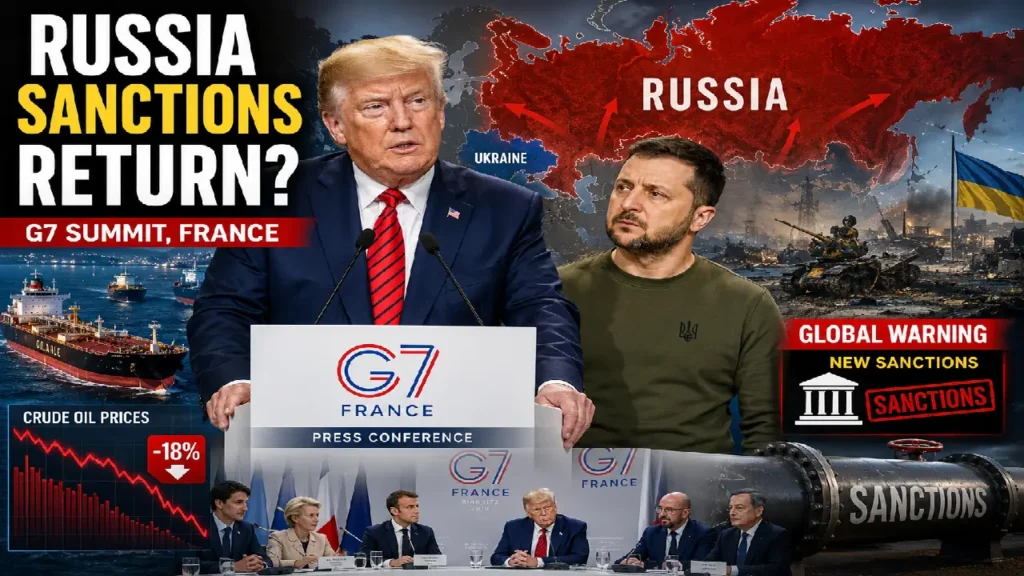
At the G7 Summit in Évian-les-Bains, France, President Donald Trump delivered one of his strongest messages yet toward Moscow. Trump suggested that the United States could soon restore sanctions on Russian oil shipments and publicly called on Russia to reach a peace agreement with Ukraine.
The statement immediately drew global attention because sanctions on Russian energy exports remain one of the most powerful economic tools available to Western countries.
At the same summit, Trump met Ukrainian President Volodymyr Zelensky and discussed the future of the war, military support, and diplomatic efforts to bring the conflict to an end. Trump stated clearly: “Russia should make a deal.”
What Is the Latest Development?
The biggest headline from the G7 Summit was that Trump Warns of Sanctions Reimposition on Russia after months of uncertainty regarding Washington’s policy toward Moscow.
Trump indicated that sanctions on Russian oil exports could return soon because global oil markets have stabilized following recent developments in the Middle East and the reopening of Strait of Hormuz.
The statement signals a tougher stance toward Russia at a time when Western nations are trying to increase pressure on President Vladimir Putin to negotiate an end to the Ukraine war.
Key Points
- Trump signaled possible reimposition of sanctions on Russian oil.
- Trump met Zelensky during the G7 Summit in France.
- Trump said Russia should make a deal to end the war.
- G7 leaders discussed stronger sanctions against Moscow.
- Ukraine urged more pressure on Russian oil exports.
- Several Western countries announced additional sanctions.
- Global energy markets closely monitored the development.
Why Trump Warns of Sanctions Reimposition on Russia
The United States had temporarily allowed certain waivers related to Russian oil shipments during periods of instability in global energy markets.
Those waivers helped prevent sharp increases in fuel prices while conflicts in the Middle East disrupted supply chains.
However, recent diplomatic developments involving Iran and improved oil market conditions have reduced concerns about supply shortages. As a result, Washington is now considering bringing back restrictions on Russian oil exports.
Trump told reporters that falling oil prices and increased global supply may allow the United States to act more aggressively against Russian energy exports.
Trump Meets Zelensky at G7 Summit
One of the most closely watched events at the summit was Trump’s meeting with Zelensky.
The two leaders discussed the battlefield situation, diplomatic options, and future negotiations with Russia.
According to reports, Zelensky argued that Russia is losing momentum and that now is the right time to increase pressure on Moscow. He also pushed for stronger sanctions targeting Russia’s oil exports and financial sector.
Following the meeting, Zelensky said there was broad agreement among G7 leaders that Russia is not winning the war and should be encouraged to negotiate.
G7 Leaders Increase Pressure on Moscow
The G7 nations remain united in their support for Ukraine.
Leaders from France, Germany, Canada, the United Kingdom, Japan, Italy, and the United States discussed additional measures aimed at increasing economic pressure on Russia.
Possible actions include:
Russian Oil Restrictions
New restrictions on oil exports and shipping networks.
Financial Sanctions
Measures targeting banking transactions and financial institutions.
Military Production Controls
Restrictions designed to reduce Russia’s ability to expand military production.
Why Russian Oil Matters
Russia remains one of the world’s largest energy exporters.
Oil and gas revenues provide a significant portion of Moscow’s government income.
Western governments believe that limiting Russian energy revenue can reduce Moscow’s ability to finance military operations.
That is why the possibility that Trump Warns of Sanctions Reimposition on Russia attracted immediate attention from global markets.
Impact on Global Oil Markets
Energy traders are carefully watching the situation.
If sanctions are restored, Russian oil exports could face additional obstacles.
However, analysts note that increased supplies from the Middle East may offset some of the impact.
The reopening of Strait of Hormuz and the recent US-Iran diplomatic breakthrough have improved confidence in global oil supplies.
This is one reason why Washington appears more willing to consider tougher sanctions now.
Can New Sanctions Push Russia Toward Negotiations?
This remains one of the biggest questions.
Supporters of sanctions argue that economic pressure can encourage negotiations.
Critics argue that sanctions alone rarely force immediate policy changes.
Nevertheless, Western leaders increasingly believe that stronger measures are needed to create conditions for meaningful peace talks.
What Zelensky Wants
Zelensky used the summit to push for:
- More military assistance.
- More air defense systems.
- Stronger sanctions.
- Greater diplomatic pressure on Russia.
- Peace negotiations before winter.
The Ukrainian leader emphasized that international unity remains essential for Ukraine’s security.
What Happens Next?
Several developments are expected in the coming weeks:
Possible US Sanctions Decision
Washington may decide whether to formally restore restrictions on Russian oil exports.
More G7 Coordination
Allied countries are expected to coordinate future sanctions packages.
New Diplomatic Talks
Efforts may continue to arrange direct or mediated negotiations between Russia and Ukraine.
Energy Market Monitoring
Governments and investors will monitor oil prices and supply conditions closely.
The development in which Trump Warns of Sanctions Reimposition on Russia marks a potentially important turning point in Western policy toward the Ukraine war.
By signaling tougher economic pressure, meeting with Zelensky, and calling on Russia to negotiate, Trump has added new momentum to international efforts aimed at ending the conflict.
Whether sanctions return or diplomacy succeeds remains uncertain. However, one thing is clear: the Ukraine conflict remains a top priority for the world’s leading economies, and the coming months could shape the future of European security for years to come.
click on ‘Read more‘ for the latest news