
The world’s most important oil shipping route is once again at the center of global attention.
After months of tension, military confrontation, and fears of a major energy crisis, a significant diplomatic breakthrough has emerged. The US-Iran Agreement Reached on Strait of Hormuz is being viewed as one of the most important geopolitical developments of 2026.
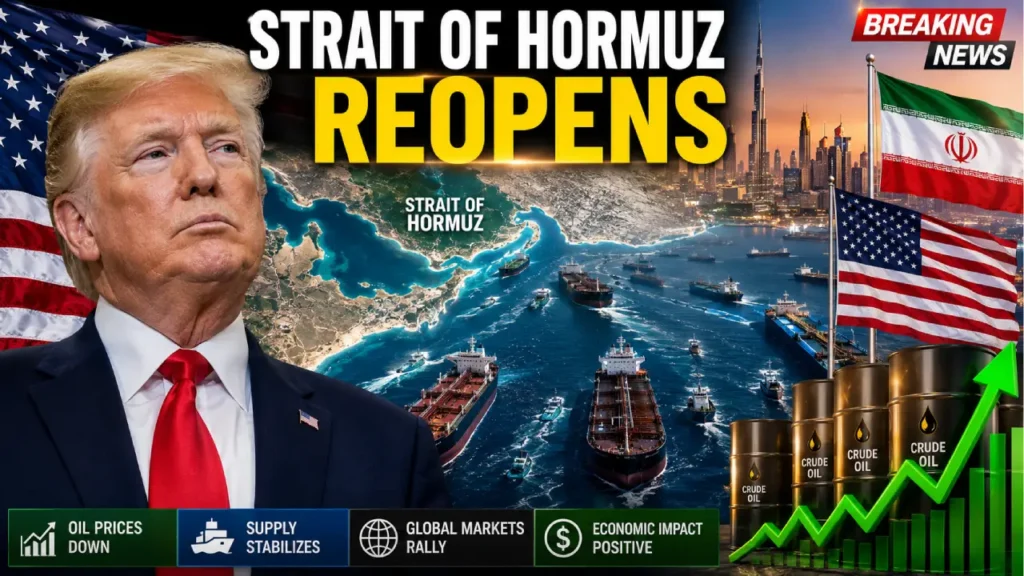
President Donald Trump announced that the Strait of Hormuz would be reopened under a new understanding between Washington and Tehran. Reports also indicated that Iranian crude oil tankers were moving out of the area affected by the US naval blockade. The development immediately influenced oil prices, shipping markets, and diplomatic relations across the Middle East.
What Is the Issue?
The Strait of Hormuz is one of the world’s most strategic waterways.
Nearly one-fifth of global oil trade passes through this narrow route connecting the Persian Gulf to international markets. Any disruption affects oil prices, inflation, shipping costs, and energy security worldwide.
For several months, tensions involving the United States, Iran, Israel, and regional actors created uncertainty around maritime traffic in the area.
The newly announced US-Iran Agreement Reached on Strait of Hormuz aims to restore shipping activity and reduce the risk of a wider regional conflict.
Key Highlights
- President Trump announced a framework agreement with Iran.
- Strait of Hormuz reopening became a central part of the understanding.
- Iranian oil tankers reportedly resumed movements.
- Oil prices dropped after the announcement.
- Global leaders welcomed the diplomatic breakthrough.
- Australia and several countries eased some travel advisories for parts of the Middle East.
- Further negotiations are expected regarding Iran’s nuclear program and regional security.
US-Iran Agreement Reached on Strait of Hormuz: What Trump Announced
President Trump stated that the Strait of Hormuz would be fully open and operational under a new memorandum of understanding between the United States and Iran.
According to reports, the agreement includes measures designed to restore commercial shipping and improve maritime stability. Trump described the deal as a major step toward reducing tensions and ensuring uninterrupted global trade.
The announcement was made during international diplomatic discussions and quickly became one of the most discussed geopolitical developments worldwide.
Why the Strait of Hormuz Matters
The Strait of Hormuz is not just a regional waterway.
It is one of the most important energy corridors on Earth.
Every day, millions of barrels of crude oil move through this route. Major oil producers such as Iran, Saudi Arabia, Iraq, Kuwait, and the United Arab Emirates depend on it for exports.
When shipping is disrupted:
- Oil prices rise.
- Fuel costs increase.
- Global inflation pressures intensify.
- Supply chains face delays.
That is why the US-Iran Agreement Reached on Strait of Hormuz attracted immediate attention from governments, investors, and energy companies around the world.
Iranian Oil Tankers Begin Moving Again
One of the most significant developments following the agreement was the reported movement of Iranian crude oil tankers.
Reports indicated that multiple tankers carrying millions of barrels of oil started leaving storage and export zones after restrictions were eased. Iran also began preparing for increased crude exports to Asian markets.
Energy analysts believe that increased Iranian exports could help stabilize global oil supplies if the agreement remains effective.
Impact on Global Oil Prices
Financial markets reacted immediately.
Oil prices fell sharply after the announcement because traders expected additional supplies to enter global markets.
Brent crude and West Texas Intermediate both recorded notable declines following news of the agreement and reopening plans.
Experts said the market response reflected optimism that shipping disruptions could ease and supply chains might normalize over the coming months.
International Reactions to the US-Iran Agreement Reached on Strait of Hormuz
The agreement received a largely positive international response.
Many governments described the development as an opportunity for regional de-escalation and economic stability.
The United Nations welcomed diplomatic efforts aimed at reducing tensions. Several European countries also expressed support while emphasizing the importance of continued negotiations.
Countries dependent on imported energy closely monitored the situation because stable shipping through the Strait of Hormuz directly affects fuel availability and prices.
Australia Lowers Travel Warnings
Another notable consequence of the diplomatic progress was the adjustment of travel advisories.
Australia reportedly lowered travel warnings for several Middle Eastern destinations after signs of reduced regional tensions emerged.
While governments continue to monitor security conditions, the move was interpreted as a sign that some countries believe the immediate risk of escalation has decreased.
Challenges Still Remain
Despite the optimism, several challenges remain unresolved.
Regional conflicts involving Israel and Hezbollah continue to create uncertainty. Recent violence in Lebanon has already raised questions about the long-term durability of the agreement.
There are also ongoing discussions regarding:
Nuclear Negotiations
Future talks are expected to address Iran’s nuclear program and broader security arrangements.
Maritime Security
Shipping companies remain cautious because insurance costs and operational risks have not fully returned to normal levels.
Regional Stability
Diplomatic progress depends on reducing conflicts across multiple areas of the Middle East.
Background: Months of Tension Before the Agreement
The current breakthrough follows months of confrontation.
The Strait of Hormuz experienced repeated disruptions during the broader regional crisis involving Iran, the United States, and Israel.
Military operations, shipping restrictions, naval deployments, and diplomatic negotiations all contributed to uncertainty in global energy markets.
Several international efforts were launched to restore navigation and prevent a prolonged energy crisis. The latest agreement represents the most significant diplomatic achievement so far.
Expert Analysis
Energy experts believe the agreement could provide short-term relief to global markets.
However, they also warn that long-term stability depends on successful implementation.
If shipping continues normally and Iranian oil exports increase, energy prices could remain relatively stable. But any renewed military escalation could quickly reverse those gains.
Geopolitical analysts say the agreement demonstrates that diplomacy remains possible even after periods of intense confrontation.
What Happens Next?
Several developments are expected in the coming weeks:
- Further US-Iran negotiations.
- Monitoring of maritime traffic.
- Expansion of Iranian oil exports.
- International discussions on regional security.
- Potential agreements related to nuclear issues.
- Continued monitoring of Lebanon-related tensions.
The success of the US-Iran Agreement Reached on Strait of Hormuz will ultimately depend on whether both sides fulfill their commitments.
The US-Iran Agreement Reached on Strait of Hormuz marks one of the most important diplomatic developments of 2026.
President Trump’s announcement of a reopened Strait of Hormuz, combined with the resumption of Iranian oil tanker movements, has already influenced global energy markets and international diplomacy.
While major challenges remain, the agreement offers hope for improved stability in one of the world’s most strategically important regions.
The coming weeks will determine whether this breakthrough becomes a lasting peace initiative or merely a temporary pause in regional tensions.
click on ‘Read more‘ for the latest news