
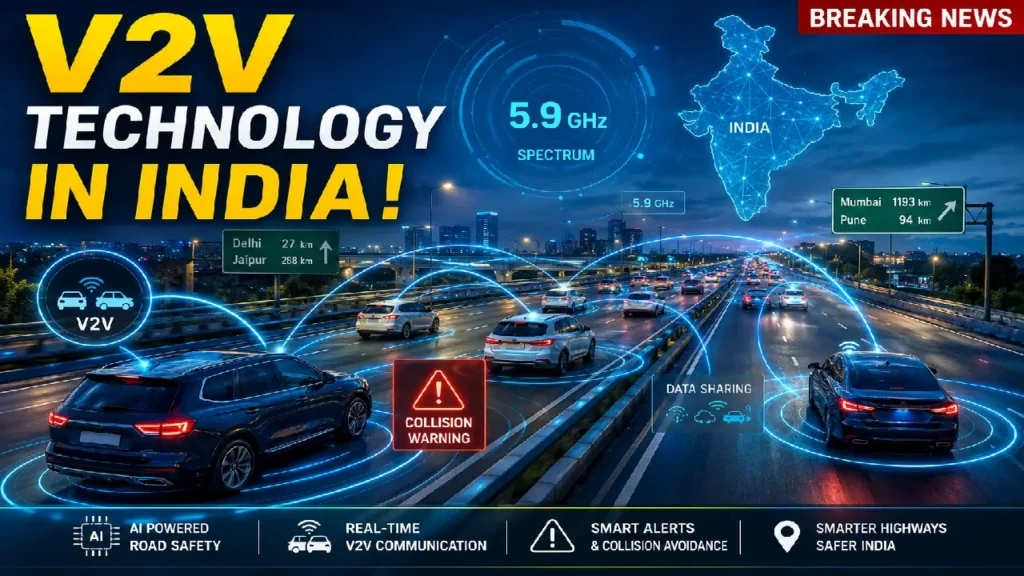
India has taken a major step toward safer roads. The decision on V2V Spectrum De-Licensed in India could transform how vehicles communicate and help reduce road accidents.
The Government of India has removed licensing requirements for 30 MHz spectrum in the 5.9 GHz band, allowing Vehicle-to-Vehicle (V2V) and Vehicle-to-Everything (V2X) communication technologies to operate more easily across the country. This move is expected to speed up the adoption of advanced safety systems in cars, buses, trucks, and future smart transportation networks.
With India reporting more than 177,000 road deaths in 2024, experts believe connected vehicle technology could become one of the biggest road safety upgrades in decades.
What Is the V2V Spectrum De-Licensed in India Decision?
The V2V Spectrum De-Licensed in India decision means automakers and technology providers can now use the 5.9 GHz band without obtaining separate spectrum licenses.
The spectrum is designed specifically for:
- Vehicle-to-Vehicle communication (V2V)
- Vehicle-to-Infrastructure communication (V2I)
- Vehicle-to-Everything communication (V2X)
- Smart traffic management
- Emergency vehicle alerts
- Collision avoidance systems
The move aligns India with global standards already used in the United States and European Union.
Key Highlights
Main Points
- 30 MHz spectrum in 5.9 GHz band de-licensed
- Supports V2V and V2X communication
- Real-time safety alerts between vehicles
- Helps prevent accidents and collisions
- Supports future autonomous vehicle technology
- Aligns India with US and EU standards
- Benefits automakers and technology companies
- Can improve Bharat NCAP safety ecosystem
What Is Vehicle-to-Vehicle Communication?
Vehicle-to-Vehicle communication allows vehicles to exchange information directly.
Cars can continuously share:
- Speed
- Direction
- Braking status
- Position
- Road conditions
- Hazard warnings
This communication happens within milliseconds.
As a result, drivers receive warnings before they can even see the danger.
For example:
A truck suddenly brakes around a blind curve.
A connected vehicle behind it immediately receives an alert and warns the driver.
This extra reaction time can prevent a deadly crash.
How V2V Technology Can Save Lives
Warning About Blind Curves
Many accidents occur because drivers cannot see vehicles approaching from the opposite direction.
V2V systems can send instant warnings.
Wrong-Way Driving Alerts
If a vehicle enters a road in the wrong direction, nearby vehicles can receive alerts immediately.
Emergency Vehicle Notifications
Ambulances, police vehicles, and fire services can communicate with nearby traffic.
Drivers receive advance warnings and can create a path faster.
Construction Zone Alerts
Vehicles can receive information about:
- Road repairs
- Open pits
- Diversions
- Lane closures
Weather Hazard Alerts
Future systems can share:
- Fog warnings
- Rain alerts
- Low visibility information
Why India Needs V2V Spectrum De-Licensed in India
India has some of the world’s busiest roads.
Challenges include:
- Heavy traffic
- Mixed vehicle movement
- Pedestrians
- Animals on roads
- Poor lane discipline
- High-speed driving
Traditional sensors and cameras cannot detect every danger.
Government studies found many traffic risks occur beyond a driver’s line of sight.
Experts say V2X communication fills this critical safety gap.
Impact on Automobile Industry
The V2V Spectrum De-Licensed in India decision is expected to help both Indian and international manufacturers.
Potential beneficiaries include:
- Maruti Suzuki
- Tata Motors
- Mahindra & Mahindra
- Mercedes-Benz
- BMW
Technology suppliers may also benefit:
- Bosch
- Continental
- Qualcomm
Connection With Self-Driving Technology
Although India is still far from fully autonomous vehicles, this policy lays an important foundation.
Modern self-driving systems rely on:
- Radar
- Cameras
- Sensors
- Vehicle communication
The government also removed licensing requirements for radar spectrum in the 77–81 GHz range, helping advanced driver assistance systems (ADAS) grow faster.
Bharat NCAP and Future Safety Ratings
A government panel has recommended including V2X technology in Bharat NCAP safety evaluations.
This could encourage manufacturers to install connected safety systems in more vehicles.
Over time, these features may move from premium cars to mass-market vehicles.
Expert View
Road safety experts believe connected vehicle technology could become as important as airbags and seatbelts.
The biggest advantage is prevention.
Instead of protecting passengers after a crash, V2V technology aims to stop accidents before they happen.
That makes it one of the most promising transportation safety innovations in recent years.
What Happens Next?
The next phase will involve:
- Technology testing
- Industry deployment
- Vehicle integration
- Smart road infrastructure
- Safety certification
Automakers are expected to gradually introduce V2V-enabled vehicles in India over the coming years.
The V2V Spectrum De-Licensed in India decision represents a major milestone for Indian road safety.
By opening the 5.9 GHz spectrum for connected vehicle communication, India has created the foundation for smarter, safer, and more intelligent transportation.
If implemented successfully, this technology could help prevent thousands of accidents, reduce road fatalities, improve emergency response, and move India closer to the future of connected mobility.